Prevention Division
Prevention Division
Targeted Intervention
MIZORAM STATE AIDS CONTROL SOCIETY: TARGETED INTERVENTION DIVISION 2007 – 2025
Mizoram SACS have been implementing Targeted Intervention (TI) projects engaging Non-Governmental Organizations (NGO) to reach out to High-Risk Groups, Bridge Population with HIV prevention services including Clinical services.
High Risk Group
The key risk groups covered through TI Program include:
1. Injecting Drug Users
2. Female Sex Workers
3. Men who have Sex with Men
4. Migrants
Targeted Interventions are preventive interventions focused at High Risk Groups and Bridge populations in a defined geographic area. The TI Projects are peer-led interventions implemented through NGOs/Community Based Organizations (CBO). These projects are mentored, monitored and supported by State AIDS Control Societies. (SACS), Technical Support Unit (TSUs) and NACO. The NGOs/CBOs implementing the TI Projects collect field level data based on the reporting formats developed by NACO which form a part of national Monitoring and Evaluation framework.
Prevention strategies under TI focus on the following major components to reach the goal of halting and reversing the HIV epidemic among HRGs and Bridge population:
Behavior Change Communication
Treatment for sexually transmitted infections
Distribution of condoms and other risk reduction materials.
Ownership building
Creating an enabling environment
Needle syringe exchange program
Opioid substitution Therapy.
Link Worker Scheme
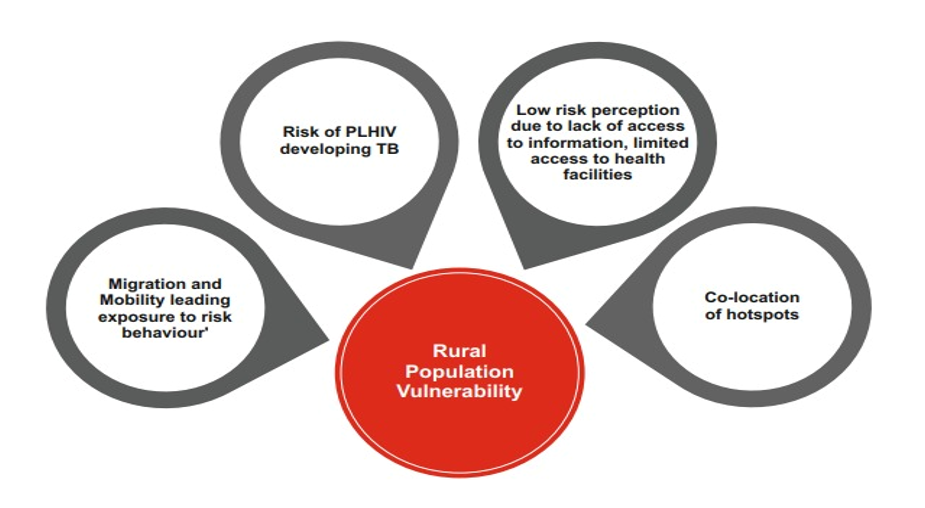
LWS aims to address complex needs of rural population for HIV prevention, care and support.The scheme offers HIV prevention, referral, and follow-up services for HRGs and other vulnerable populations. The introduction of LWS has enhanced comprehension of the dynamics of sex work in rural areas and the repercussions of migration-related transmission dynamics.
Objectives of the Link Worker Scheme
1. The scheme aims at building a rural community model to reach out to HRGs, bridge population and other vulnerable population to address the prevention, testing, treatment and care requirements for HIV and STI in select geographies.
2. The scheme aims at improving access to information materials, and commodities (condoms, needles/syringes, OST, lube) through a multi-prong approach.
3. The scheme aims at creation of an enabling environment for PLHIVs, HRGs and Other Vulnerable Population towards reduction of stigma and discrimination by strengthening community structures and systems.
4. The scheme aims at improving linkage to other social and health benefits provided by other line departments in line with local norms and regulations suitable for vulnerable populations.
Features of LWS
The salient features of LWS are as follows:
1. The scheme uses evidence-based approach to identify rural areas with greater risk and vulnerabilities of contracting HIV through scientific tools such as broad mapping.
Individuals/groups within the villages are prioritised for providing information and services based on detailed situation needs assessments.
2. The scheme envisages creation of demand and provision of various HIV and STI
related services and linking of the target population to existing services points under
the revised Guidelines.
3. The scheme involves highly motivated and trained community members Cluster Link
Worker for clusters of villages – who will establish linkages between the community on one hand and information, commodities and services on the other.
4. The scheme envisages creating an enabling and stigma free environment in the project
area to ensure continued access to information and services in a sustained manner.
5. The scheme envisages creating linkages with services of other health departments through ASHA, Anganwadi Workers, panchayat heads, MNREGA scheme officials, Red Ribbon Clubs etc.
Opioid Substitution Therapy
Opioid Substitution Therapy substitutes an illicit drug with a medically safe, long acting, legal medication. It is prescribed by a medical doctor and administered under the supervision of a trained nurse or pharmacist. The substituted drug is taken orally (sublingually) instead of injecting.
· Harm Reduction has multiple tiers of service delivery
· Along with NSEP, Oral substitution therapy (OST) is a well accepted strategy for HIV prevention, and forms the second tier of harm reduction
· OST is substitution of the drug user’s primary drug of use with a medically safer drug
· OST is substitution of primary route of use (injecting) with non-injecting route (Oral/ Sublingual)
Other Activities under TI
Community Based Screening (CBS): Community Based Screening was rolled out in 17th October 2017 first in Aizawl based TI’s and eventually for all TIs and 3 LWS. With the introduction of CBS we have observed that HRGs who were unwilling to undergo HIV testing are not taking the test which shows that they are not reluctant to test but are reluctant to move out of their comfort zone to places like ICTC. CBS reaches HRGs in their comfort zone and is able to yield more results than during the time when HRGs had to go to ICTCs. However, a challenge remains in confirming the reactive cases to ICTC, for which best efforts are being made in close co-ordination with Basic Service Division.
Mass Awareness: Due to the rapid growth of HIV transmission among both HRGs and general community, major awareness programs need to be conducted in various platforms. The church being a very influential entity in the state, Mizoram SACS is working closely with the biggest denomination, the Presbyterian Church Synod, and the Church has agreed to come up with a 5 year plan, the details of which is under process where MSACS is a member of the committee.
Apart from these, individual churches are requesting for HIV and drug awareness among young children and youth which has been repeated positively by MSACS with full support from Project Sunrise. Church advocacy and awareness is expected to increase as more requests are received.
Bike Outreach Workers
Goal, objectives
The overall goal of the innovation is to bridge the gap in saturation coverage of HRGs and their indexed communities through an amplified mobile service through Bike Outreach in these far-flung areas which can only be reached by two wheelers vehicles to ensure successful achievement of the 95-95-95 targets. Under this the objectives will be to realize the following deliverables:
· Address HRGs client either LFU or newly identified which cannot be reached by TIs due to problem in geography
· contacting of clients inclusive of commodities distribution & exchange and access of services provided by the prevention unit (TI-NGOs)
· HIV Counselling and screening, TB screening, Hepatitis screening, STI/RTI/UTI
· ART linkage and refill, adherence, ART check-up, step up counselling
· Index identification, referral, on the spot-referral (s)/navigation
· SDNS identification and maintenance, advocacy and awareness
· Viral load monitoring, sample collection
· Linkage to treatment and prevention services to TIs e.g DSRC/ICTC, OSC, OST
· Convergence and linkage with other prevention and care and support services
· Efficacy of revamped strategies adopted, identification of gaps and evolving issues and troubleshooting measure (to be provided in the spot).
Prison & Other Closed Settings
The key features of interventions are listed below:
- Comprehensive HIV intervention in line with the international standards and practices Saturate coverage of all people living in prisons and other closed settings.
- Creation of enabling environment to increase access of services during stay and post release at par with the services available in the general community.
- Enhanced partnerships with key stakeholders for collective responsibility and long-term sustainability.
- Mainstreaming the HIV, Syphilis, STI and TB intervention inside P&OCS
- IT enabled platform for real-time monitoring and reporting
- Build the capacity of staff engaged in the implementation of P&OCS Interventions and the enhanced collaboration with police training academies and jail training schools to sensitize and train the key functionaries of government agencies
- Coverage of prison sites under the HIV Sentinel Surveillance (HSS) to make the intervention more systematic and evidence-based C.
Core eligible services provided to inmates in P & OCS .
- Information, Education and Communication
- HIV Counselling, Screening/ Testing
- HIV Care, Support and Treatment
- Elimination of Vertical Transmission of HIV and Syphilis
- Prevention and Treatment of Reproductive Tract Infections/ Sexually Transmitted Infections
- Drug Dependence Treatment Opioid Substitution Therapy & Drug De-Addiction services
- Prevention, Diagnosis and Treatment of Tuberculosis and Mental Health Services through line departments
- Post release linkages to enable continuity of access to services
The list of services mentioned above does not limit the scope of services that are to be provided to inmates. Stakeholders are encouraged to identiff the health need of the inmates and suggest bringing in new service providers to address their needs adequately. It is also important to link the eligible inmates for social protection services that are made available by central and state governments besides providing health services